Red foot variations (2018)

Variations of the Red Foot was a solo exhibition held at AT | AL 609 in December 2018. The proposal was to execute it within a conception of an open and phenomenological system. The pieces were presented interdependently as a single installation. To this end, three concepts were important to explore its conception. The first concerns an approach that disqualifies the affective-associative memory of the works initially created for Atelier Contágio, giving primacy instead to a spatial presentness. This approach also required an aesthetic emphasis on the continuity between the objects, or their network – a transcoding to the field of creation of Capra's biophysical concept, as well as the theory of complex systems, which addresses emergent properties. This concept raised the question of what properties were created from the interaction between the arranged elements and how to empirically evidence them (without a scientific imperative). In a more general sense, there was a nomadic nature to the creative process and the pieces themselves, understood through the relationships between the materials and the space, as well as their inherent meanings. This implies that the specific circumstances encountered altered several stages of the artistic process: the production of the works, their presentation (curatorship/exhibition design), and consequently, the way visitors experience the pieces.
TECHNICAL SHEET
Curated by: Cecilia Stelini
Exhibition design and assembly: Camilla Torres and Mathias Reis
Production: Camilla Torres
Graphic design: Mathias Reis
Photography: Raphael Wohnrath (promo), Camillat and Mathias Reis


ATRACTOR Instação, 6x2,5m Terra, aglutinante, troncos carbonizados e hortaliças ressecadas tingidas com pigmento mineral
‘Para quem vive em São Paulo, pé vermelho é quem é de Campinas. Para quem vive em Campinas, pé vermelho é quem é de Paulínia. Para quem é de Paulínia, pé vermelho é quem é de Piracicaba. Para quem é de Piracicaba, pé vermelho é só lá no Mato Grosso. Afinal quem é o pé vermelho, esse sujeito que é sempre o outro? Quem é esse outro, um duplo, que se constitui apenas para ameaçar uma desejada identidade cosmopolita? A terra vermelha, ou terra rossa/terra roxa já foi um derrame vulcânico na separação de grandes continentes, muito antes do sinal de qualquer hominídeo caminhar por esse planeta. Foi a partir de sua fertilidade que as plantações de cana e de café prosperaram, a partir de sua rica floresta usada como lenha nos engenhos e como escora para a taipa de pilão, que com a argila formaram os assentamentos de cidades ricas o suficiente para pavimenta-la e esconde-la de vista.
 |  |  |
|---|---|---|
 |  |
 |  |  |
|---|---|---|
 |
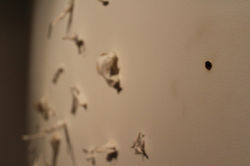
ESPAÇO FÁSICO Instação, 3x2,8m Ossos, orifício ocular e fotografia (60x90cm Pimento mineral em papel algodão 300g/m2 Tiragem 1/5)
ATRACTOR Instação, 6x2,5m Terra, aglutinante, troncos carbonizados e hortaliças ressecadas tingidas com pigmento mineral
It is upon its foundation that the colonial dystopia creates an identity of negation, leaving it available to the interests of agribusiness and construction companies. For the South African philosopher Archie Mafeje, the great conflicts in what we now know as Africa arose from the idea that the land belongs to someone, whereas previously certain groups of people belonged to specific lands. The inversion between men who belong to the land and lands that belong to one man is also crucial for us to consider when thinking about the "red foot" (referring to the indigenous people). The land crosses continents, borders and boundaries between states, the limits between public and private, inside and outside; it is irreverent to any order, as it is infected with the characteristics of each place and ends up infecting one another. It is a subtle, constant movement and sometimes a brutal earthquake. It is the land that germinates, it is the land that decomposes – they try to bury us with it, but it is in it that we can cultivate something. If decanted in water, it separates into three phases: sand, from which we make glass; clay, from which we extract pigment for paint; and silt, a transitional layer that makes up the bulk of the mass for mud constructions. The white walls of farmhouses soon acquire a red pigment base coat blown by the wind, which is covered by the inhabitants with white lime. Ironically, even covered in white, their interior remains mud. The wall then becomes an exemplary permeable boundary, where sometimes white prevails over red and sometimes the earth reclaims it. Somehow, this conflict between red and white seems to shed light, to focus attention on each other, generating a new, specific, and poetic situation. Although we cannot see it, beneath the surface the earth permeates everything. Long before houses were built, it was already visible in the beaten earth floors of the huts, in the cooking pots and water jugs of the indigenous people, red from head to toe. The earth's interference in our lives is no less than our interference with it. When we walk on it, we are unaware of much of what happens underground, the lives and phenomena related there – an uncertainty as dark as a lump of coal. If we take a hoe and dig, we find an event caused by our action; what was there before remains a mystery because we do not know the earth outside of our interference. It is intertwined in many ways in our subjectivity. The being belonging to the red earth, the so-called 'red foot', varies among all these territories. Who is he, after all? If he is everyone, then he is nobody. But this is only true if we consider the "red foot" as an identity, which it is not. "Red foot" is a multiple agency that aggregates difference, even if someone denies it; it understands its own variation. "Red foot" only becomes an identity when, like any becoming-minority, it becomes a symbol of resistance to oppression. Even so, identities are fragile, susceptible, because, as the poet Wole Soyinka warns us, "the color of the feet doesn't matter when one wears the oppressive boot."
Mathias Reis, 11 de dezembro de 2018.
 |  |  |
|---|---|---|
 |  |